Notes on Complexity and Alignment

Complex adaptive systems are interesting things. Whether its a team of robots trying to play football, or a society of human beings trying to solve a complex problem, understanding how they work and why they don’t is important. I’ve spent a number of years researching how emergent, self-organising systems form, and align themselves successfully to achieve tasks. This is a slightly random high-level set of notes about of how I think about these systems.
Whats in a system?
A multi-agent system is… a system of agents. So, what is an agent? When we think of an agent we think of some form of intelligence1, acting autonomously. Where the agebt can perceive its environment, then take actions that will affect things to bring it closer to achieving its goals. The goals of agents in a system may not be the same, and may work against each other.
So, what broad types of system are out there?
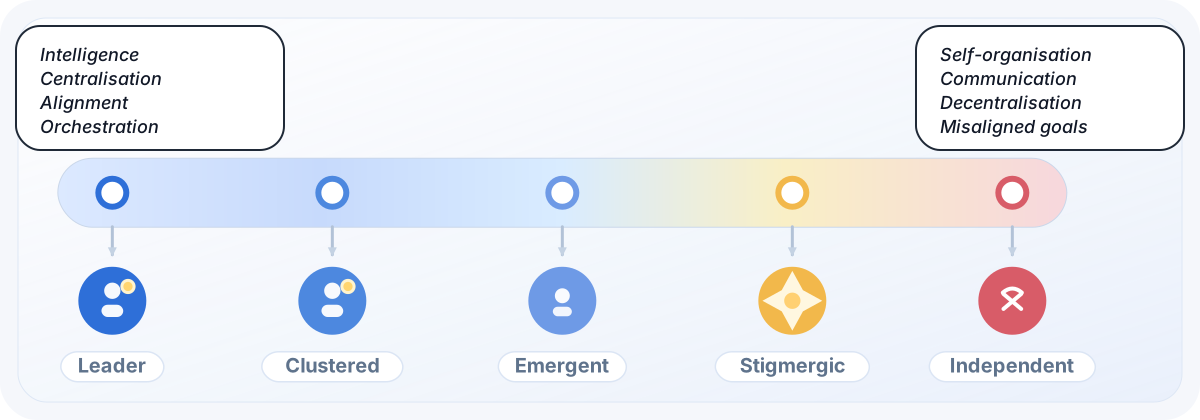
‘Leader’
A system with a dominant agent that coordinates others.
- An agent takes on the coordination, communication, and orchestration of subtasks to complete a complex task.
- Agents in the system respond to subtasks given to them by the orchestrating agent.
- Agents completing subtasks only need to be able to do a subset of tasks
- Agents completign subtasks don’t need to communicate or orchestrate between themselves.
- The leader agent has a high degree of cognitive load, which grows exponentially with the complexity of the tasks and the number of agents in the system.
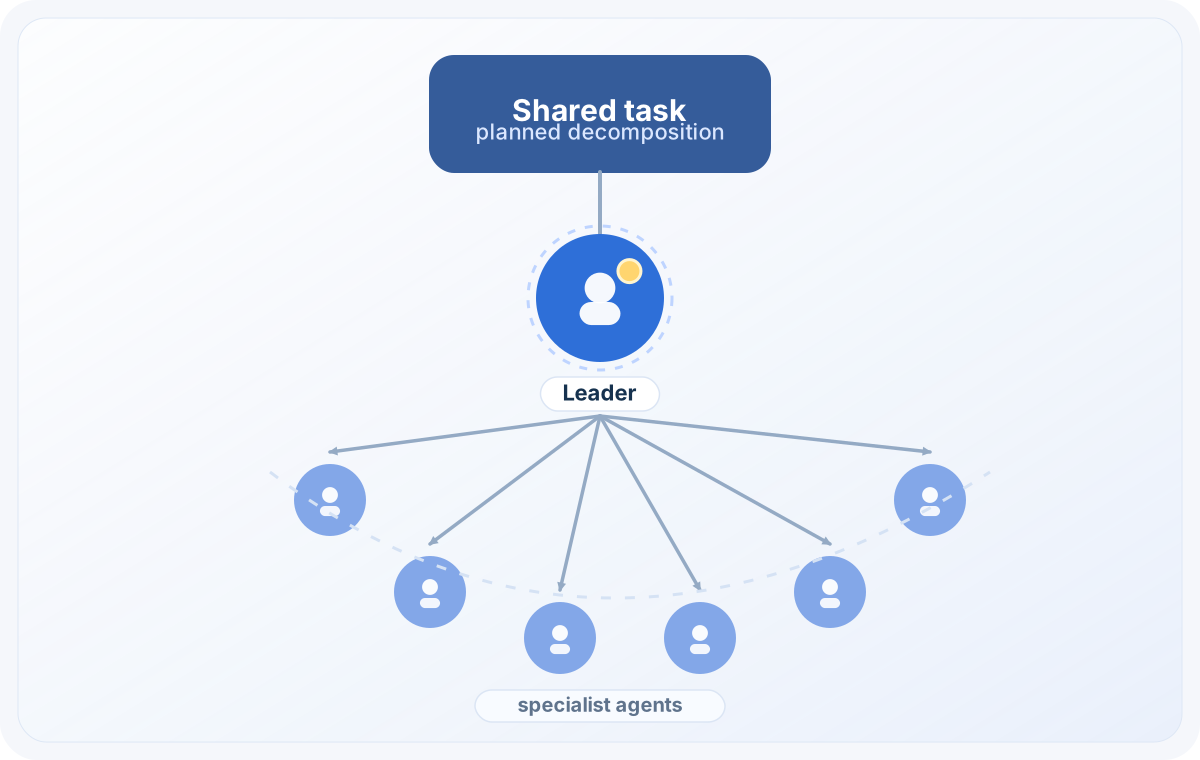
'Leader'
‘Emergent’
Agents in the system self-organise, with no over-arching agent orchestrating things.
- Agents must communicate with each other to allocate subtasks.
- Agent goals are individual.
- Alignment is ‘soft’, achieved through communication amongst agents.
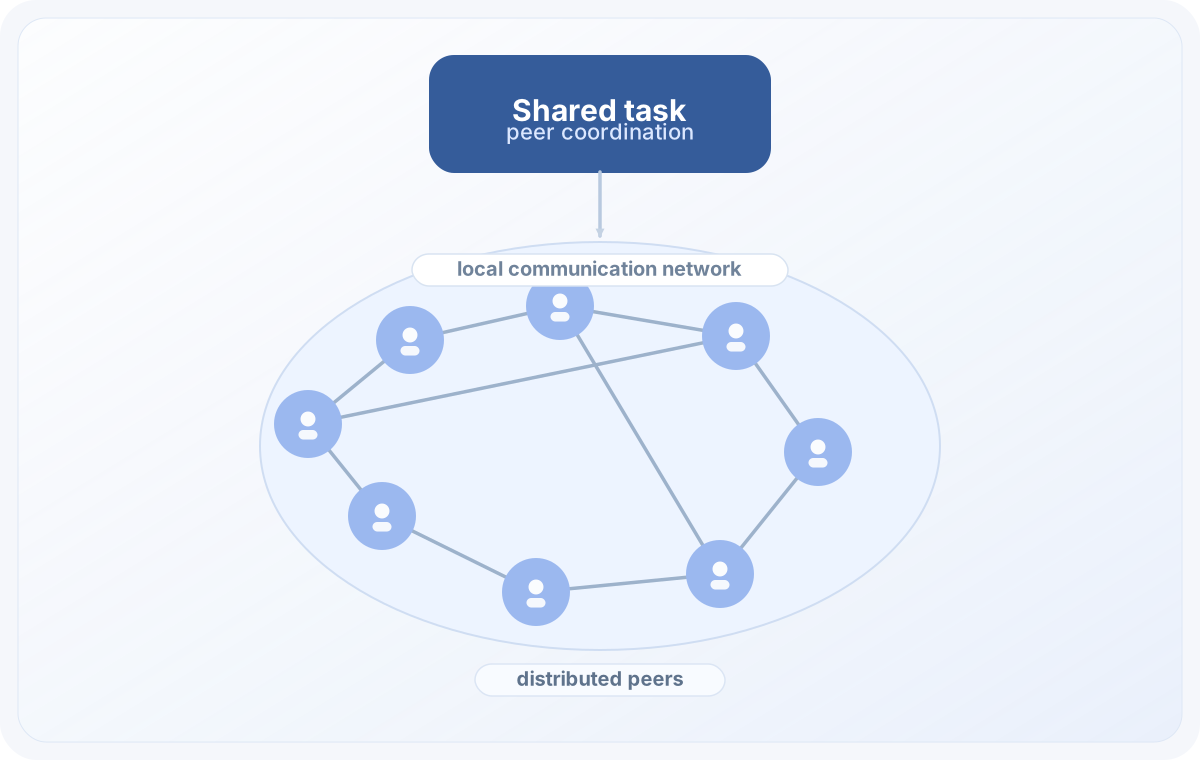
'Emergent'
‘Clustered’
A hybrid mixture of leader and emergent.
- Agents form cluster groups, where one agent acts as a sub-leader, orchestrating subtasks amongst agents in the group.
- One agent is the leader, orchestrating sub-leaders in the system.
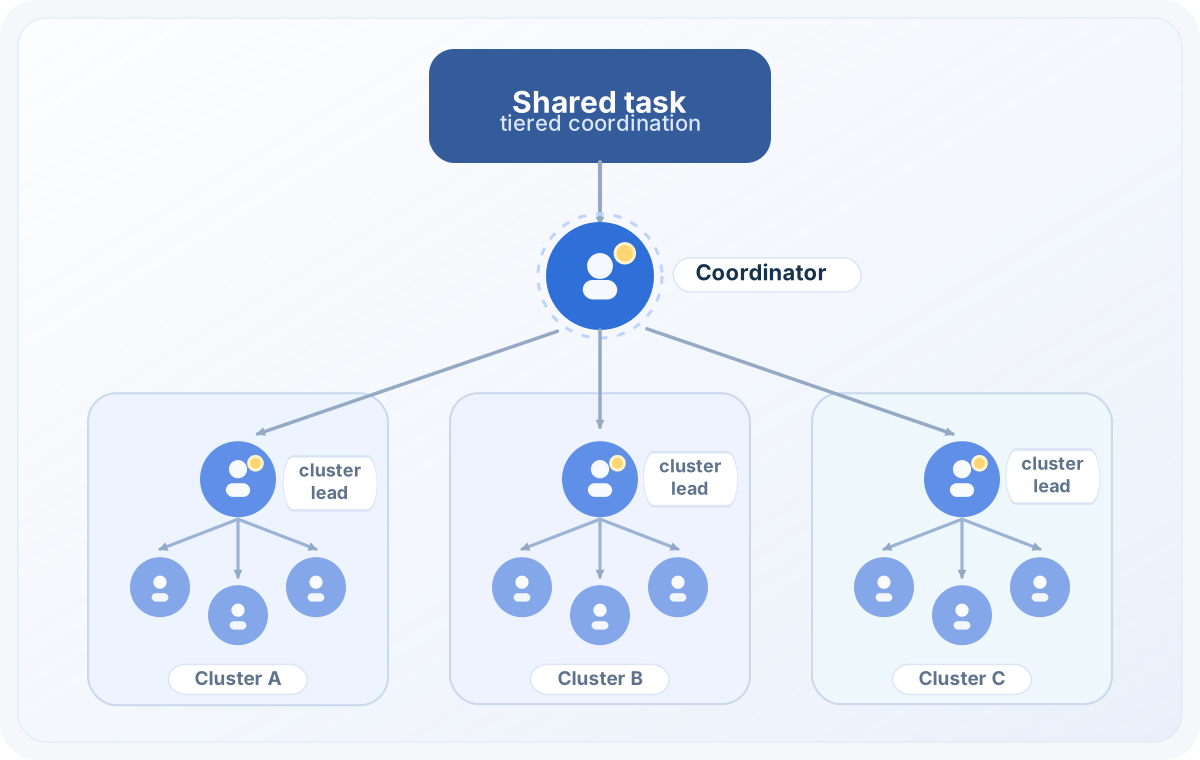
'Clustered'
‘Stigmergic’
Agents in the system self-organise without direct communication with each other.
- Agents align through indirect communication (e.g. leaving pheromone markers as ants do).
- Agents may align through some sort of reward system intrinsic to the environment, complex task, or ‘intrinsic motivation’ of the agents (e.g. the system has a point heat source and agents are rewarded for being warm).
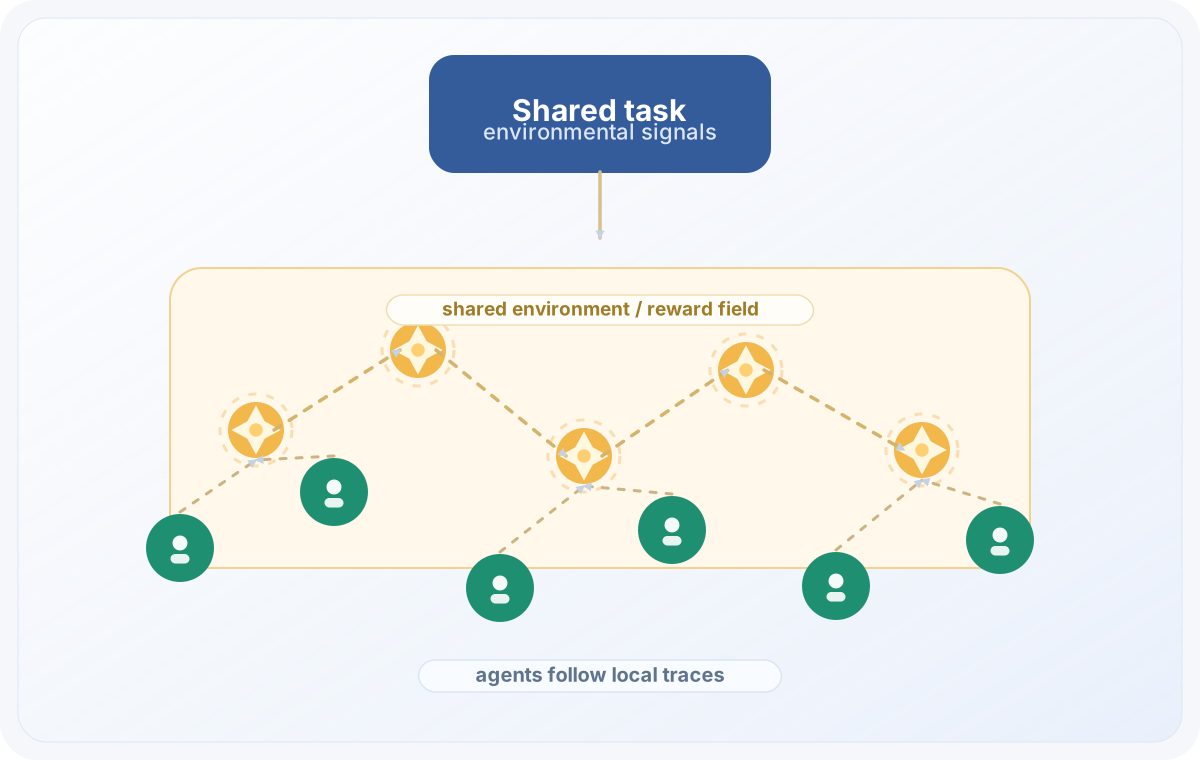
'Stigmergic'
‘Independent’
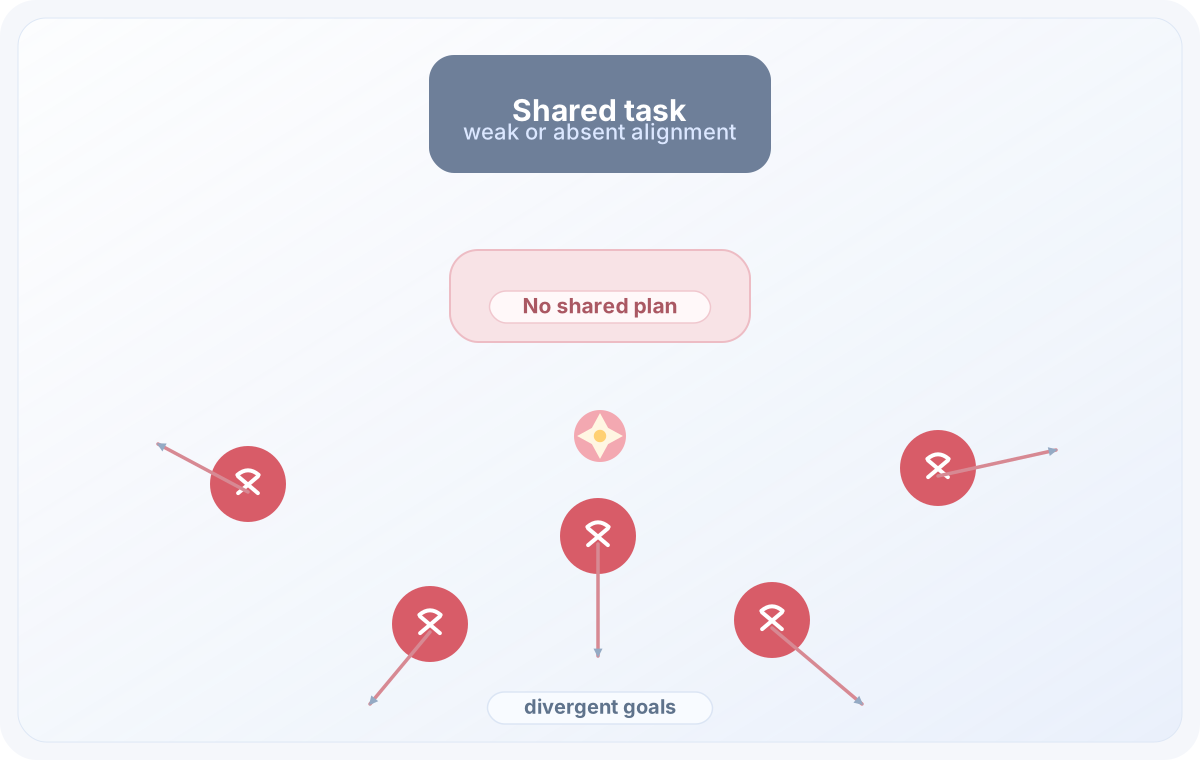
A system where there is no alignment between agents.
- All agents are acting to achieve their own goals.
- Agent goals are not coordinated by an orchestrating agent, so they’re not aligned to the overarching complex tasks to be completed.
- No communication is required as no one is collaborating with anyone else.
'Independent'
What do these agents actually do?
- a complex task to do, comprised of multiple simpler tasks
- agents can:
- do complex tasks themselves - requiring lots of skills but is completely aligned
- Direct orchestratation, agents conplete simpler tasks of a complex task under direction an orchestrating agents. Much more coordination required by a quite-intelligent agent to build alignment.
- Stigmergy - indirect, where agents autonomously complete tasks with an underlying alignment property that drives the system.
Why care?
Fundamentally, the nature of these systems and how they organise places a limit on the complexity of the task. This limitation is the definition of competition between systems. For example, a species that is prey may develop protections from its predators, requiring those predators to develop a more complex strategy to eat. If one predator species cannot achieve this more complex task, and another can, the predator that has a task-complexity limitation will be pushed towards extinction.
EXAMPLES
Intelligence and coordination
Coordination is the hidden cost of turning lots of capable agents into one useful system. An individual agent might be highly competent in isolation, but once a complex task is broken into dependent subtasks the system also needs some way to allocate work, sequence actions, resolve conflicts, and deal with partial failures. Intelligence therefore is not only about solving a task directly; it is also about deciding who should do what next and how much context they need to do it well.
This is why a single very capable agent can sometimes outperform a loosely connected group on smaller problems. The coordination overhead can dominate the actual work. As task complexity rises, however, one agent eventually becomes a bottleneck and the ability to spread cognition and action across multiple agents becomes more important than the raw intelligence of any one part.
The spectrum of independence

The useful question is not simply whether a system has one agent or many, but where it sits on a spectrum between central control and full autonomy.
At one end, a central controller has the strongest overall view of the task and can deliberately allocate work. This improves alignment but also concentrates communication load and failure risk. In the middle, clustered systems trade some global oversight for scalability, allowing local groups to coordinate more cheaply while still retaining higher-level structure. At the far end, highly autonomous agents operate with minimal central direction, which reduces orchestration overhead but makes shared intent much harder to maintain.
The best place on this spectrum depends on the task. Stable, predictable, tightly-coupled work often benefits from stronger central coordination. Open-ended, changing, or spatially distributed work tends to reward more decentralised forms because agents can react locally instead of waiting on a single planner.
Failures of coordination
"Each organisational pattern fails in a different way. "
Leader-heavy systems fail by bottleneck. As more agents are added, the coordination burden grows faster than the leader’s ability to reason, communicate, and recover from mistakes. The result is not just slower execution, but degraded task allocation because the system cannot keep a coherent picture of what is happening everywhere at once.
Highly decentralised systems fail in the opposite direction. They can have plenty of action and adaptation, but not enough shared intent. Agents may work hard on locally sensible behaviours that do not compose into a useful global result. In other words, the problem is not lack of activity, but lack of alignment.
Clustered and hybrid structures sit between these failure modes. They reduce the cognitive burden on a single leader, but they introduce interface problems between groups. Communication can still break down, local optimisations can conflict with system-wide goals, and fixed hierarchies can become brittle if the task changes shape.
Self-organisation and adaptive structure
One of the most interesting possibilities in multi-agent systems is that the coordination structure itself might be allowed to emerge. Instead of imposing a single permanent topology, agents can adapt how they communicate and organise according to the task, the environment, and the behaviour of neighbouring agents.
This is attractive because static structures are rarely optimal across all conditions. A system may need something leader-like for one phase of work, something clustered for another, and something closer to stigmergy when the environment itself can carry enough information to guide behaviour. Self-organisation offers a way to search for the right structure rather than assuming it in advance.
The difficulty is that this does not remove design work; it moves it. If we want good coordination to emerge, we must design the incentives, signals, and local interaction rules carefully enough that desirable global behaviour becomes the natural outcome.
Alignment with autonomous agents
Autonomy only becomes useful at scale if agent goals are aligned strongly enough with system goals. There are broadly two ways to think about this.
Top-down alignment pushes intent into the system through task allocation, constraints, and orchestration. Agents are directed toward work that best supports the overall goal. This works well when the coordinating layer can observe enough of the system to make good decisions.
Bottom-up alignment tries to make useful behaviour emerge from local incentives. Agents learn which tasks create value for others, which actions unlock future work, and which patterns are rewarded by the environment. This is more flexible and often more scalable, but it is also harder to guarantee. The challenge becomes one of reward shaping and interaction design rather than explicit control.
In practice, the most robust systems usually mix both approaches. They allow enough autonomy for agents to adapt locally, while providing enough structure that local optimisation does not drift too far from the system’s actual purpose.
So, which strategy is best…
Funnily enough, ‘it depends’!
- ‘Big blob’ strategy requires some sort of unlimited agent, perhaps an AGI with boundless resources. It can achieve its complex task, without requiring other agents. This is where humans get turned into paperclips
- ‘Independent’ too is not a very successful approach, in that the agents have no alignment and what the system achieves overall is highly unpredictable or random.
- ‘Leader’ and ‘Clustered’ are very common strategies. Human organisations are often organised this way, smaller orgs with flat-structures following ’leader’, and as they scale to larger orgs, the limitations of having an all-knowing leader meaning that we have sub-groups, ‘hybrid’ structures. The leader and hybrid approaches are restricted in complexity by the intelligent capacity of the leader and/or sub-leaders that form the group. There is no requirement that these systems are homogeneous however, AI orchestrators in human orgs are likely to be good fits for these alginment and orchestration roles in organisational structures.
- ‘Emergent’ and ‘Stigmergic’ are in-theory, very resilient strategies. Agents will adapt and organise themselves to complete the complex task. However, this requires ’the creator’, the architect of the system, to have had a deep understanding of behavioural rewards and alignment properties when designing the system.
So, which group wins…
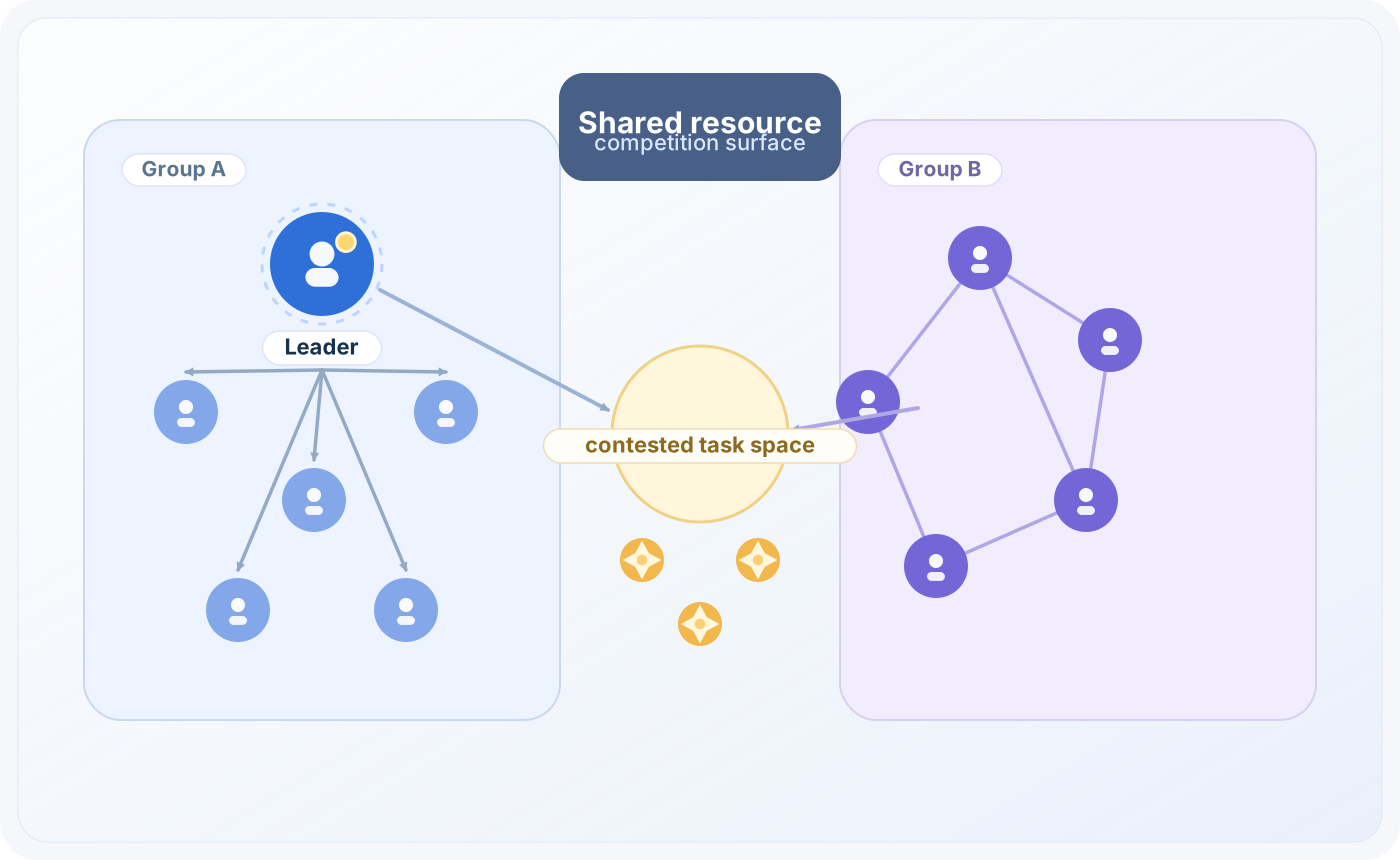
Now, imagine we no longer having seperate MAS with seperate goals. But instead, one complex shared task or goal. With all these different methods of group organisation, which will win the competition. For example, if the groups are species sharing a habitat, and the shared goal is a shared source of food, this competition can be existential.
If the group is leader based, then it will be limited by the maximum intelligence of that leader, how big do brains get? If the group is more self-organised, then the ‘design’ of the stigmergic or group reward shaping will dictate their alignement, and therefore their agility to compete.
So, what are our limits?
To help think about the limitations inherent in the structure of the system we can think of:
G, the set of agents in the system
CT, the complex task the system is to complete
Ok, so given these elements of the system, we can think of some pseudo-maths that measure things about the system and the agenst in it.
intel(G), the intelligence of agents in the system G. This is a simplistic measure of the ability of an agent to orchestrate other agents, allocate all the subtasks of a complex task etc.
align(G), the alignment of the goals of the agents G to the system goal.
comms(G), the communication demands of the agents in the system.
We can then talk about the variance var and the maximum max of these values.
We can then think of our systems as:
’leader’:
intelligence is high variance with high maximum In other words, we ahve differentiated roles, a leader agent must have higher intelligence than normal to orchestrate other groups.
alignment is high The leader guides the goals of other agents in the system by providing them subtasks, this ensures that agents do not have misaligned goals.
communication demands are high variance with high maximum Communications centralise on the leader, with much less communication between other agents in the system.
Overall, the limitations are set by the intelligence required by the leader, and the bandwidth of its comnmunication channels.
‘self-organised’
intelligence is low variance (homogeneity) As agents are not leaders, and instead are autonomous and operating with a local neighbourhood, there is no need for a ‘super-agent’ to plan and orchestrate them all.
alignment is weak Localisation and lack of system-wide view mean that agents are less aligned with each other.
communication demands are low variance and low max With local neighbourhoods of communication and more decentrlaisation, there is also less funnelling of communication messages.
The limits here are not intelligence or commication, but instead the ability of the system to generate alignment of disparate agent goals.
-
Intelligence is a difficult topic, but however its defined, there are definitions of MAS and resulting behaviours that do not require intelligent agents. ↩︎